
The Birdpage
I'm doing a project where I try to take a photo of every bird in the UK! I mean, every type of bird. Not literally every bird. That would be really stupid.
First and foremost, this is about collecting photographic proof of having encountered each kind of bird - it's not an art project. Getting good photos is a strictly secondary concern. Hence, some of these images are a bit craptastic - if I later get the chance to swap them out for nicer ones, I will do so. At present, my only rules for the project are that the bird photos have to be at least recognisable and that I have to capture the pics myself.
One or two of the birds below were snapped in captivity and not in the wild, which I'm aware is (a) "cheating" and (b) super lame as far as most birdwatchers are concerned. I don't currently care: this is just a bit of fun and a way for me to learn a bit more about the natural world.
At the moment, this page is pretty much entirely a record of the birds I've been able to find in and around my usual stomping grounds (mostly Kent and London) via whatever means.

 Collared dove
This familiar dove only arrived in the UK in the mid-1950s and has since become one of our most common birds. They've been spreading around the world at a furious pace and can now be found just about everywhere, a bit like Starbucks.
 Wood pigeon
Wood pigeons have a very similar call to collared doves, but with a different number of notes. (Wood pigeons usually sing five coos, whereas collared doves sing three). You can distinguish them from feral pigeons by the large white spot on their neck and pinkish breast.
 Feral pigeon
Absolutely everywhere in every town and city in the UK and available in all sorts of strange colours. Ancestrally, they're descended from our native wild rock dove. They're much smarter than people think (they can recognise themselves in mirrors, and are capable of sorting photographs into categories). And although everyone thinks of them as being disgusting airborne plague rats, it's very unlikely a human would catch anything off a pigeon. There are people who work with and handle pigeons every day and almost never get sick.
 Blackbird
Blackbirds are found abundantly on every continent save for Antarctica. They play a vital ecosystem role wherever they appear, as they control insect numbers and disperse seeds as they forage around. Also, if you have four and twenty of them, you can bake them in a pie.
 House sparrow
House sparrows are sociable little things and often hang out in big mixed groups of male and female birds. Once absolutely common as muck, but in recent decades apparently in decline. House sparrows are now on the UK's Red List for bird conservation as they seem to be disappearing fast.
 Robin
RobinNoisy, abundant little birds that can actually be fiercely territorial and aggressive despite their cosy Christmas associations. Recently voted the UK's favourite bird, which to my mind is a bit like voting Toby Carvery as the nation's best restaurant. I could probably get a better photo than this but honestly I can't be bothered.
 Starling
Often covered in small white spots during the cooler months. Apparently Mozart once had a pet starling that could sing an excerpt of his Piano Concerto in G Major. This makes me want to get one so I can teach it to do Forgot About Dre.
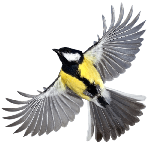
 Great tit
By my reckoning these are roughly as common as blue tits and sometimes get misidentified as such by non-birdwatchers. Great tits like to nest in holes, but they aren't too fussy what they use (no, I'm not going to make the obvious joke). I'm told they have been known to set up shop in post boxes.
 Blue tit
I don't know why I haven't yet managed to get a really good photo of a blue tit, because I've seen them a bunch of times. I just can't seem to get lucky when I have a camera to hand. Easily distinguished from the great tit by the pale ring around its head cap and smaller overall size.
 Long tailed tit
A round little fluffy golf ball of a bird with a long tail as the name would suggest. They tend to do quite badly in harsh winters as they have little defence against the cold, and their population levels have been known to decline by up to 80% in such conditions. But they always seem to bounce back as they are keen breeders.
 Ring necked parakeet
A famously divisive bird. Some people see them as cute and colourful, others see them as an invasive pest species. Either way, they've been living in the UK for long enough that they are basically native now. Very common in London parks especially.
 Pied wagtail
Cute little black-and-white birds that seem to love hanging around in car parks for some reason. You see them at motorway services a lot. They're twitchy little things that always seem to be darting around, their little tails waggling up and down. Surprisingly, they can live a good long while - apparently the oldest known wagtail so far lived for over 11 years.
 Grey wagtail
Much harder to find than the pied wagtail. Grey wagtails are easily identified by their yellow undercarriage. They're drawn to bodies of water - the one pictured (blurrily) above was spotted frolicking around near the beaver pond at Wild Wood, Herne.
 Song thrush
Famously partial to escargot. Song thrushes are known to pick up snails and bop them on rocks to crack their shells open.
 Herring gull
Everyone knows these bin-bag-ripping, chip-stealing bastards. Very easy to get a picture of since they spend so much time standing around doing nothing and are utterly unfazed by humans.
 Black headed gull
These distinctive little gulls can live to a ripe old age and reach 30 years or more in some cases. Known for their distinctive call, which sounds like someone doing a really annoying laugh.
 Mallard
Absolutely the most common and recognisable type of duck in the UK. I only learnt embarrassingly recently that the males can lose their green heads and go brown all over after their summer breeding season, and thus a lot of the 'female' brown ducks I'd been seeing were actually male. You can tell them apart because male ducks have got bright yellow beaks with a black bit at the end, whereas females tend to have duller, greyish beaks.
 Mute swan
A common sight on most local rivers and lakes. People talk a lot about how you've got to be careful around swans because they can break a man's arm - that's bollocks and it's literally never happened. Swans have got big wings but the bones are light and relatively fragile. In a clash between human arm and swan wing, you'd win.
 Moorhen
 When the beak on the head / is distinctive and red / that's a moorhen
  Chaffinch
Chaffinches are pretty little birds and I'd like to get a better photo of one soon. We don't seem to get many of them down my way, although apparently they get a population boost in the winter months when large numbers of them migrate over from Scandinavia, so I shall keep my fingers crossed.
 Greenfinch
I've seen these chunky, pretty finches turn up infrequently out and about in Canterbury, although I haven't yet figured out a method or place to find them reliably. Unfortunately, they seem to be in decline in recent years as they have been having a lot of trouble with a fast-spreading disease called trichomonosis. Owners of bird feeders and tables and the like are encouraged to routinely clean everything to help prevent the spread, and to stop feeding completely for a couple of weeks if they should spot any sickly-looking or dead birds in the immediate area.
 Goldfinch
I think goldfinches might be my favourite little birds - I love seeing a crowd of them in a tree, chattering and singing together. We have a lot of drab-looking birds here in the UK, but a group of goldfinches flying overhead is such a wonderful splash of colour. Happily, their population numbers are apparently booming, so I'll look forward to seeing more of them (and hopefully getting a better picture) sometime soon.
 Green woodpecker
The green woodpecker doesn't often do the classic woodpecker 'knocking' sound; you're more likely to hear its distinctive 'laughing' call. I've been trying to get a less shit photo of one for ages.
 Dunnock
Despite its very boring grey-and-brown appearance, the dunnock probably has a more interesting life than you'd think - both male and female dunnocks are polyamorous and enjoy sleeping around with multiple partners. When they're not doing that, they seem to spend most of their time hopping around on the ground and hiding under bushes.
 Magpie
Smart, distinctive corvid with the Latin name Pica pica ( ). Internationally, there are other types of magpies that aren't black and white. In South Asia they have blue magpies, as well as adorable-looking bright green ones with little bandito masks on.
). Internationally, there are other types of magpies that aren't black and white. In South Asia they have blue magpies, as well as adorable-looking bright green ones with little bandito masks on.  Carrion crow
Despite the name, carrion crows will eat just about anything: grains, eggs, chicks, worms, nuts, fruit. Jaffa Cakes? Probably.
 Jackdaw
These corvids are on the smaller side and very smart. I'm told they can identify individual humans, but nobody is quite sure how they do this. A little less common than magpies by my reckoning, but still reasonably abundant and easy to find.
 Rook
RookGot a distinctive plague-doctor beak. Something about the shape of their profile makes me think of Sneezeman from Modern Toss. Can only move in straight lines on a chessboard.
 Jay
Jay
I love jays, and it took me almost a full year of trying before I was able to catch a halfway decent photo of one. The jay pictured above was just chilling in my back garden; I only ever seem to see them out there in the winter months. Possibly they venture further out of the Blean and university woods in colder periods - I couldn't tell you. Either way, I was very pleased to capture the above JPEG (a JayPEG, if you will).
 Chough
Choughs used to be native to Kent, but have been extinct here for a couple of hundred years. They appear on the Canterbury town crest and in local legends, but don't live here any more (although they can still be seen in Cornwall and elsewhere). Happily, Wild Wood in Herne is currently doing a project to re-establish a breeding population (which is where I snapped the two birds shown above).
 Raven
RavenAn absolutely bloody massive corvid. Fiercely intelligent and able to mimic human speech as well as other animal sounds. Well-known for its ability to find creative solutions to puzzles. The photo is of a bird in captivity at a sanctuary; I have yet to see one in the wild. Apparently they live almost everywhere in the UK except the east side of the country, so maybe I just live in the wrong place. People used to persecute them in days gone by as they were perceived to be farmland pests, but now they are a protected species and their populations have started to recover.
 Kestrel
A dinky-sized falcon adept at hovering on the wind. Likes to hang in the air and look around for small, unfortunate animals it can swoop in on. Being a bird of prey, its eyesight is bonkers: apparently it can even see ultraviolet light.
 Grey heron
These water birds are extremely light and spindly (they weigh about half as much as a goose). Sometimes people put fake plastic herons next to ponds to frighten birds away, like a scarecrow. Most amusingly, this has no effect whatsoever and might actually attract more birds to the area.
 Little egret
Originally from the Mediterranean, this egret has been seen more and more frequently in the British Isles in recent decades. The one pictured was seen in captivity, but I have encountered one properly in the wild before, just chilling on the banks of the Stour in the heart of Canterbury.
 Coot
CootSimilar to moorhens but with much weirder feet. They'll dive into water bodies looking for food before bringing it back up to the surface to eat, whereupon other coots will then promptly try to steal it off them. I don't think it's a very good system.
 Cormorant
These are such impressive and cool-looking birds that I almost feel like I shouldn't run across them as frequently as I do. Often seen spreading their wings out to dry after a plunge. Very easy to confuse with shags from a distance.
 Tufted duck
These are the most common diving ducks in the UK. I always think tufties are extremely cute with their spiffy little hairdos and their beady little button eyes.
 Shelduck
Shelducks like to nest in rabbit burrows and tree holes and the like. Also good at avoiding predators; their signature move is for the babies to disappear under the water while the adults fly away conspicuously to distract attention.
 Pochard
Only limited numbers of pochards live and breed in the UK, although large crowds of them have been known to migrate over from mainland Europe in the winter. This seems to have been happening less and less in recent years, as warming global temperatures have meant that their home lakes and rivers have been more ice-free and habitable.
 Red crested pochard
Very distinctive-looking duck with a round head. Not all that abundant, and the British Trust for Ornithology suspects that the majority seen around the UK are probably from private collections (at least ancestrally).
 Great crested grebe
One of those bird names that sounds like you've just started making stuff up to impress people. They've got an eccentric-looking courtship dance where the two birds face each other and take turns dramatically looking left, then right, then left again, on repeat, while occasionally shaking their heads furiously in between. No idea what that's all about, but I suppose it beats Tinder.
 Common crane
The UK's tallest bird. You can't tell in the photo, but it has a distinctive little red patch on the top of its head. Easy to identify from its large ruffle of tail feathers.
 Greylag goose
A big, plain-looking goose with an orange bill. The most goosey goose. In fact, the scientific name, Anser anser, basically means 'goose goose'. If you want a generic goose, this is your bird.
 Canada goose
A very successful and confident goose that has no shame about marching up to you and loudly demanding food. People sometimes call them 'Canadian geese', which is a faux pas if you say it in front of certain birdwatchers and might earn you a "well actually" response. It's a bit like how you're not supposed to say 'seagull' (because gulls don't only live by the sea). I really don't care about any of that stuff. As long as you're having fun, that's the main thing.
 Barnacle goose
So named because medieval people believed these birds spawned from barnacles, thanks to the time-honoured mariners' tradition of making shit up. It absolutely baffles me that people continued to believe this was the most likely explanation for their origin for several hundred years.
 Egyptian goose
Very distinctive bird with dark rings around its eyes. Despite the name, it's not really a goose; more like a big goose-like duck.
 Red breasted goose
A colourful and distinctive Arctic goose species that occasionally visits the UK in winter, although the British Trust for Ornithology thinks visitor numbers may be declining. This one was found at St. James' Park, London.
 Snow goose
Not native to the UK (it's from North America), but turns up sometimes in waterfowl collections.
 Bar-headed goose
An Indian import that ornamental waterfowl collectors like to add to parks and lakes and whatnot. There is some evidence that there might now be enough escapees that the geese are establishing proper breeding populations here in the UK; we shall have to see.
 Hawaiian goose
Also known by its Hawaiian name of nēnē (pronounced nay-nay). Actually might be the rarest type of goose on Earth; there's only about two thousand of them in the whole world. (The one pictured lives in St. James' Park).
 White stork
The only reason we have breeding white storks in the UK these days is because of a specific reintroduction program called the White Stork Project. This one was snapped in captivity at a wildlife sanctuary.
 Black swan
Black Swan is a 2010 movie starring Natalie Portman. Oh, sorry. This is an Australian bird that gets imported as an ornamental waterbird in UK parks and whatnot. I don't remember where I snapped this one. Either Hyde Park or St. James' in London, most likely.
 White pelican
Pelicans aren't native to the UK any more, but there are some living in St. James' Park thanks to a 1664 gift from a Russian ambassador. Apparently one of the park's pelicans used to routinely fly over to London Zoo to steal their fish.